
A new international study, carried out as part of the AI4SoilHealth project, has shown that combined measurements of soil organic matter (SOM) and soil organic carbon (SOC) increase our understanding of the carbon storage potential of soils with benefits for policy makers. Lead author Dr Sabine Reinsch, a soil ecologist at the UK Centre for Ecology & Hydrology, tells us more…
Why it’s important to be accurate about soil carbon
Countries must regularly report their total greenhouse gas balance to the UN’s Intergovernmental Panel on Climate Change (IPCC) whose goal is “to provide governments with comprehensive, objective, and authoritative scientific information on climate change that can be used to develop effective climate policies”.
This includes counting both emissions (like from cars) and removals (like carbon stored in trees and soil). Since soil stores vastly more carbon than the atmosphere and plants combined, accurately measuring changes in Soil Organic Carbon (SOC) is essential. This is a more specialised measure, so researchers tend to instead measure Soil Organic Matter (SOM) and then use a conversion factor to estimate SOC in soils.
Worldwide, various factors have been used to convert measurements of SOM into estimates of SOC. Using an inaccurate conversion factor means a country could be over- or under-estimating its success in storing carbon, leading to misleading messages in climate reports and bad investment decisions.
Understanding how to make better estimates of soil organic carbon
The IPCC guidance, and common scientific practice, that if SOM measurements are available instead of SOC, a conversion factor of 0.58 can be used to estimate SOC content for mineral soils, before the estimation of Greenhouse Gas emissions. Although it is acknowledged that this conversion factor of 0.58 is not accurate (and measurements of SOC are preferred but are more technically elaborate), it is a straightforward way of deriving a SOC estimate.
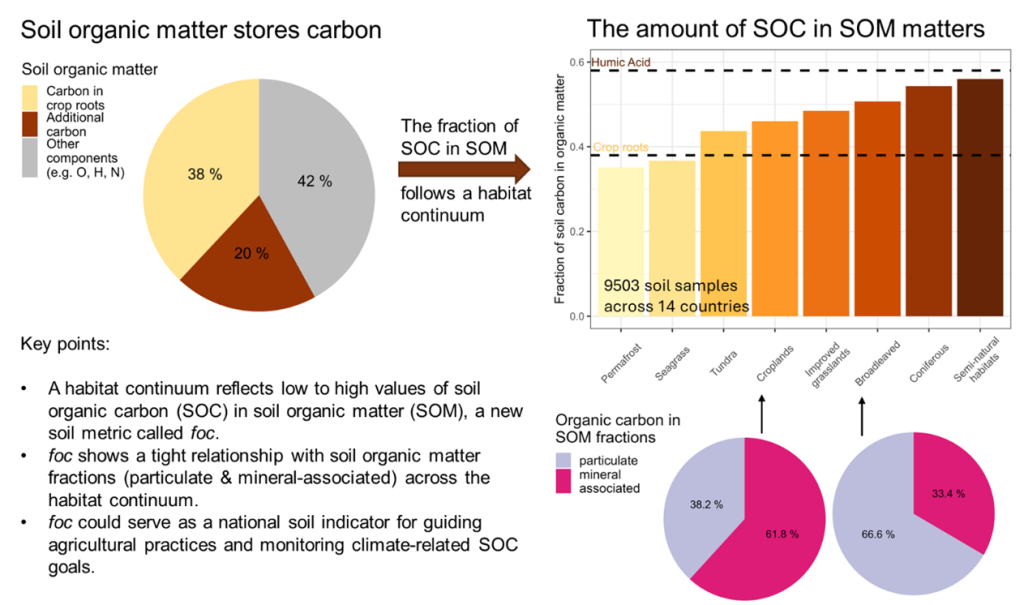
Our new research collated 9,503 data points across European, Arctic and Seagrass habitats with associated SOC and SOM measurements, to derive more accurate SOC estimates from SOM. We further discovered that types of soil and habitats together determine the amount of SOC in SOM, leading to habitats specific conversion factors, specifically for temperate regions of the world.
The work was inspired by the UKCEH Countryside Survey covering various soil types and habitats. Topsoils have been sampled since 1978 to track the condition and change of soils throughout the United Kingdom. SOC and SOM are routinely measured as part of the survey and showed a consistent relationship. We wanted to find out if combining data from SOC and SOM measurements could help policymakers to understand national scale soil carbon storage potential.
In a smaller set of samples from the UKCEH Countryside Survey, SOM was divided into its fluffy (particulate) and mineral-associated parts. The latter is thought to safeguard carbon from being consumed by soil organisms and to remain in the soil for a longer period.
Better carbon estimations for more reliable policy interventions
Having these refined, habitat-specific factors allows policymakers to make more targeted decisions on which land management practices offer the best climate benefit. This precision guides national policy and investment toward more impactful climate mitigation and adaptation strategies. For example, using a general conversion factor more likely results in an overestimation of SOC content in arable soils and is more likely to underestimate SOC contents in peatlands and woody habitats.
Our conclusion is that plants and soils together determine the amount of carbon stored in soils and its SOM. In our work, we provide habitat and soil type specific factors for conversions of SOM measurements to SOC for temperate (and Arctic) regions.
We present a promising link between the amount of carbon in organic matter and both fluffy (particulate) and mineral-protected organic matter in soils. This relationship offers a hopeful path for obtaining cost-effective estimates of carbon storage on a national level to support land management policies and practices.
Paper and data information:
Reinsch et al. 2025. The Fraction of Carbon in Soil Organic Matter as a National-Scale Soil Process Indicator. Global Change Biology. DOI: 10.1111/gcb.70572. Open access.
The SOC and SOM dataset can be downloaded from Zenodo and the soil organic matter fractionation dataset is available from the Environmental Information Data Centre.
Find out more about AI4SoilHealth’s indicator work
Building a robust indicator framework for Europe’s soils.