Healthy soil is the foundation of our entire food system – but many of the most important things happening in soil are invisible. For too long, farmers and policy makers have relied on slow, static measurements of nutrients already in the soil, like checking a bank balance. But this doesn’t reveal the nutrients that are being deposited or withdrawn. Now, AI 4 Soil Health is changing this by shining the spotlight on a well-kept secret – soil enzymes. Find out what Dr Sonia Meller of Digit Soil has to say.
Unseen workers in the soil
Soil is full of life – tiny animals, fungi, bacteria and decaying plant material. In the middle of all this activity are soil enzymes. These tiny workers act like natural machines that break down large, complex materials into smaller pieces that plants can absorb.
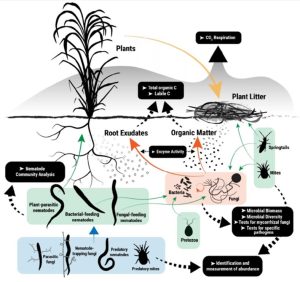
Figure 1. A typical representation of the soil food web, Brackin et al. (2017, p.149)
Here’s a short explanation:
- An enzyme is a special type of protein made by living organisms such as microbes, fungi, or plant roots
- Each enzyme has a very specific shape – like a lock that only one type of key can open.
- The ‘key’ is the substrate, the material the enzyme works on (for example, a piece of dead leaf).
- When the enzyme and substrate meet, the enzyme helps to break the material into smaller molecules.
- Plants can then take up these smaller molecules as nutrients.
This process only works when the soil has enough heat and water. If the soil is too dry, the enzymes and substrates can’t move around and the whole system slows down.
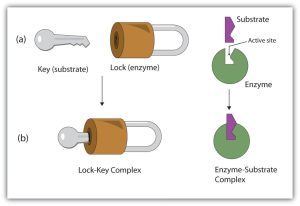
Figure 2: The Lock-and-Key Model of Enzyme Action. (a) Because the substrate and the active site of the enzyme have complementary structures and bonding groups, they fit together as a key fits a lock. (b) The catalytic reaction occurs while the two are bonded together in the enzyme-substrate complex. From https://chem.libretexts.org/Courses/Case_Western_Reserve_University/CHEM_121%3A_Concepts_for_a_Molecular_View_of_Biology_II_%28Cunningham%29/4%3A_Amino_Acids_Proteins_and_Enzymes/4.07%3A_Enzyme_Action
How soil enzymes factor into farming
To grow crops well, farmers need to know how much nutrients their soil can provide. But there’s a big missing piece in this calculation. For example, a corn crop might need 300kg of nitrogen per hectare to reach a good yield. A farmer might add 120kg through fertilizer. But how much nitrogen is the soil itself releasing naturally? This number – the soil’s contribution – is often unknown.
This matters because if the soil releases too little, crops won’t grow well. If the soil releases too much when no plants are growing, the nitrogen gets lost into water or air which wastes money, pollutes rivers and groundwater, and contributes to climate change through nitrous oxide emissions. By measuring soil enzyme activity, farmers can finally understand how much nitrogen the soil is releasing and when. This will allow them to adjust fertiliser use more accurately and avoid waste.
Want to see how this can work on a farm? See the video we’ve released with our partners:
Measuring the ‘pulse’ of soil health
In regenerative farming, the goal shifts from simply adding nutrients to managing a living ecosystem. Soil enzymes act as the “vital signs” of this biological factory, revealing the unseen work happening beneath the surface. For example, while many organic farms have phosphorus locked in complex soil molecules, enzymes called phosphatases act as biological catalysts to unlock this supply, reducing the need for external fertilisers.
Similarly, when a cover crop is terminated, it provides a “feast” for microbes; measuring enzyme activity helps to estimate when this green manure has been digested and converted into plant-available nutrients. By monitoring these signals, farmers can move from guesswork to orchestrating their soil’s natural productivity. It’s the difference between treating soil like a sterile substrate and managing it as a living, breathing asset.
The problem with measuring soil enzyme activity
Traditionally, measuring enzyme activity required expensive lab equipment, skilled technicians and complicated procedures, with a significant wait for results. Because of this, it wasn’t commonly measured by most farmers and labs.
SEAR – a solution for measuring soil enzyme activity
The Soil Enzymatic Activity Reader (SEAR) being developed by Digit Soil is a new device that makes enzyme testing 10–15 times faster (giving results in hours, not days), simpler, cheaper (no lab required) and standardised (so results can be compared across regions). This technology turns enzyme activity from a scientific curiosity into a practical tool farmers can use for real-time decision making.
Find out how to measure soil enzyme activity with SEAR, in this short video:
Developing tools for soil biology
AI4 Soil Health us using SEAR across Europe to build a large database of enzyme activity in different soils and seasons. This is important because enzyme levels change over time. They reflect biological activity in the soil, and not all seasons are equally active for soil life. By collecting this data, researchers can identify the best times to measure enzyme activity and create better soil health indicators – like how we already track soil carbon.
SEAR is a vital part of AI4 Soil health’s ‘novel sensor’ toolkit. While other methods map the soil’s genetic fingerprint via eDNA or monitor “ecosystem engineers” like earthworms, SEAR measures the actual work being done. If eDNA tells us which microbes are present, SEAR tells us how fast they are working to release nutrients. By linking enzymatic data with DNA and biodiversity markers, we have an opportunity to make biological health trackable and transparent.
Why this matters for Europe’s soil strategy
The EU’s new Soil Monitoring Law is a major step toward protecting soil health. Although enzyme activity isn’t yet included in the law, it could hopefully become a powerful addition in the future. Enzymes offer something current soil tests don’t: a dynamic, real-time indicator of how soil is functioning, not just what it contains. This could help countries move from static reports to predictive, actionable soil management.
How to get involved
Reach out to Digit Soil if you’re a farmers, researcher, soil monitoring agency or policymaker who would like to get involved. There are opportunities to test enzyme activity, contribute to the growing database, join pilot projects and/or explore new research collaborations.
References
Brackin, R. et al. (2017) “Soil biological health: What is it and how can we improve it?,” Proc Aust Soc Sugar Cane Technol, 39, pp. 141–154.
LibreTexts (2025). CHEM 121: Concepts for a Molecular View of Biology II (Cunningham) – 4.7: Enzyme Action. LibreTexts. Available at: https://chem.libretexts.org/Courses/Case_Western_Reserve_University/CHEM_121%3A_Concepts_for_a_Molecular_View_of_Biology_II_%28Cunningham%29/4%3A_Amino_Acids_Proteins_and_Enzymes/4.07%3A_Enzyme_Action