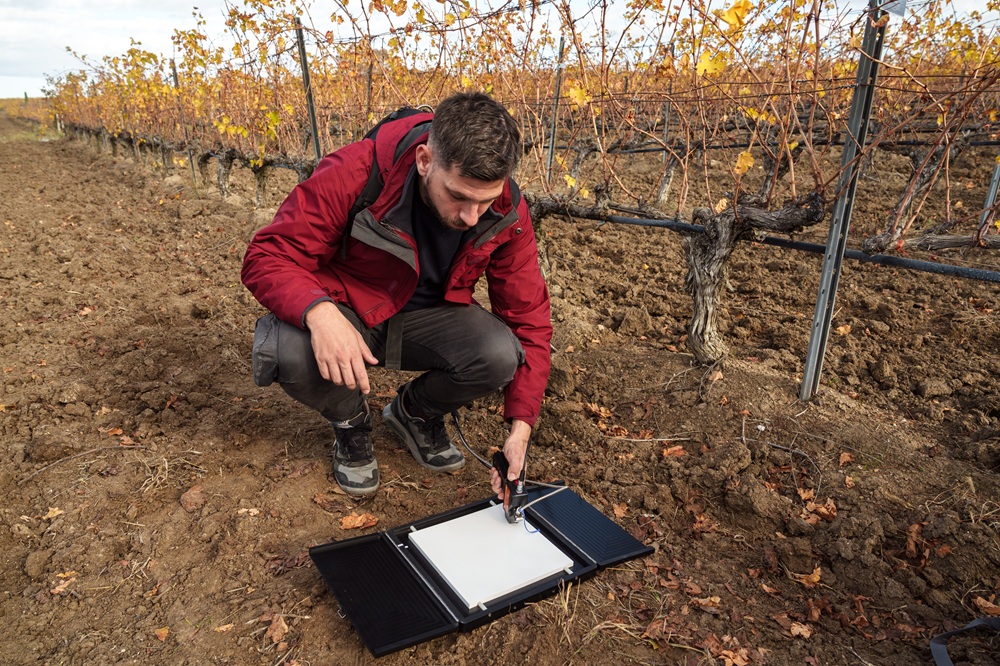


There’s a powerful but often hidden mechanism that could reshape how we measure carbon and assess soil health – particularly in croplands. Nicolas Breil’s research for INRAE explores the Rhizosphere Priming Effect (RPE), a process driven by plant roots that could reshape our understanding of the carbon beneath our feet.
The first Europe-wide estimate of RPE-induced carbon loss
Soils hold one of the largest carbon stores on the planet, yet many of the processes controlling carbon release aren’t fully understood. One of the most intriguing is RPE – when plant roots release compounds such as sugars, enzymes, and organic acids that “wake up” microorganisms in the soil. Once “woken up”, they break down soil organic matter more quickly, boosting heterotrophic respiration – organisms processing organic material, taking in oxygen and releasing carbon dioxide – and adding more carbon into the atmosphere.
RPE can increase microbial respiration by up to 300%, in lab experiments using isotopically-labelled plant material. But what happens outside the lab – across whole regions and on farms? This remains a knowledge gap. This gap matters most in croplands, where carbon turnover is high and where RPE tends to be stronger than in other environments.
To help close the gap, our research delivers the first Europe-wide estimate of RPE-related carbon loss, focusing on three cornerstone crop types: cereals, oilseeds and rooting crops.
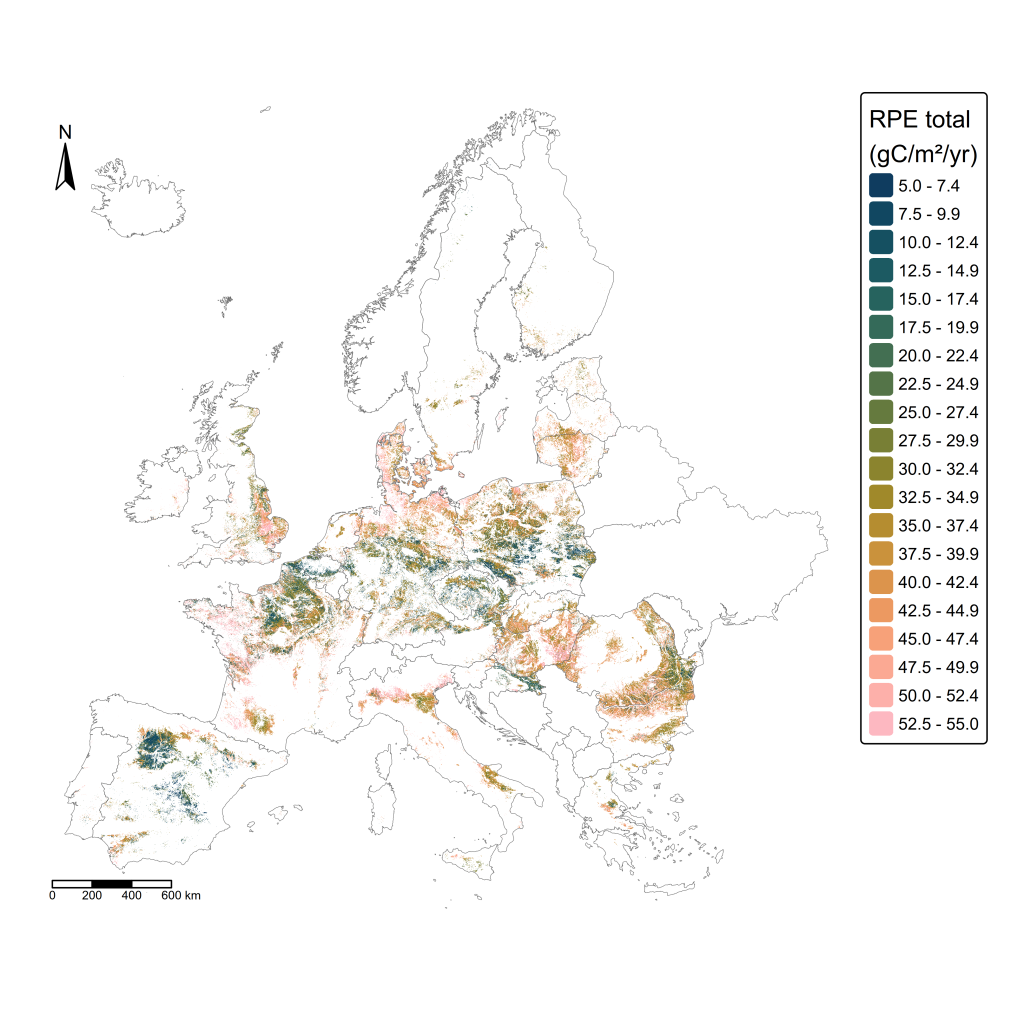
Spatial distribution of the RPE for European croplands (cereals, oilseeds, and rooting crops) for the average year of the 2010-2020 decade. Each pixel contains at least 50% of croplands for the average year between 2010 and 2020.
How can this help land managers?
We’ve found that root activity doesn’t just add carbon to soil – it plays a key role in how carbon moves, transforms and escapes back into the atmosphere. For land managers aiming to build soil carbon or adopt regenerative practices, this has important implications:
- Cover cropping, crop rotations or growing deep-rooted species can all trigger RPE, shifting soil carbon balances in ways that often go unnoticed.
- RPE may help explain why adding organic matter doesn’t always translate into long-term carbon storage – some carbon becomes primed for rapid breakdown instead.
- Healthy root-microbe interactions are essential for soil resilience and understanding them can strengthen soil health strategies.
Uncertainties remain in estimating RPE-driven carbon losses, but this research provides a solid foundation – and highlights where the largest knowledge gaps lie.
Help to advance the Soil Monitoring Law
As the EU advances its soil monitoring agenda, capturing how soils really function becomes critical. Our work, which has been presented at the EGU 2025 (Breil et al., 2025), identifies a hidden process that could significantly influence carbon accounting and soil health assessments in croplands. Our research has produced:
- A dynamic indicator, using satellite and field data to map how changes in factors such as the gross primary production, rooting depth or heterotrophic respiration influence soil carbon.
- Insights into plant-soil interactions that directly shape carbon cycling – key information for designing climate-smart agricultural policies.
Our work also strengthens AI 4 Soil Health’s mission to create reliable, scalable soil-health indicators across Europe by:
- Introducing the RPE as a dynamic, large-scale soil process that can be integrated into monitoring tools.
- Embedding biologically meaningful processes into data-driven models.
- Laying the foundation for AI-enhanced predictions of microbial activity and soil carbon fluxes, linked to vegetation and land management.
What’s next for the research?
The next phase of this research will expand to other land types, including grasslands. We’ll also explore how RPE responds to climate change, soil type, and different farming practices.
Further reading
Estimating Rhizosphere Priming in European Agricultural Soils
A GitHub page and public repository containing the code and input data will become available via our Zenodo community
References
Breil et al., 2025, Estimating Rhizosphere Priming in European Agricultural Soils, EGU General Assembly 2025, Vienna, Austria, 27 Apr–2 May 2025, EGU25-19302, https://doi.org/10.5194/egusphere-egu25-19302, 2025.
Huo et al., 2017, Rhizosphere priming effect: A meta-analysis, Soil Biology and Biochemistry, 111, 78-84.
Keuper et al., 2020, Carbon loss from northern circumpolar permafrost soils amplified by rhizosphere priming, Nature Geoscience, 13-8, 560-565.
Guenet et al., Impact of priming on global soil carbon stocks, Global Change Biology, 24-5, 1873-1883.
Wang and Kuzyakov, 2024, Soil organic matter priming: The pH effects, Global Change Biology, 30-6, e17349.