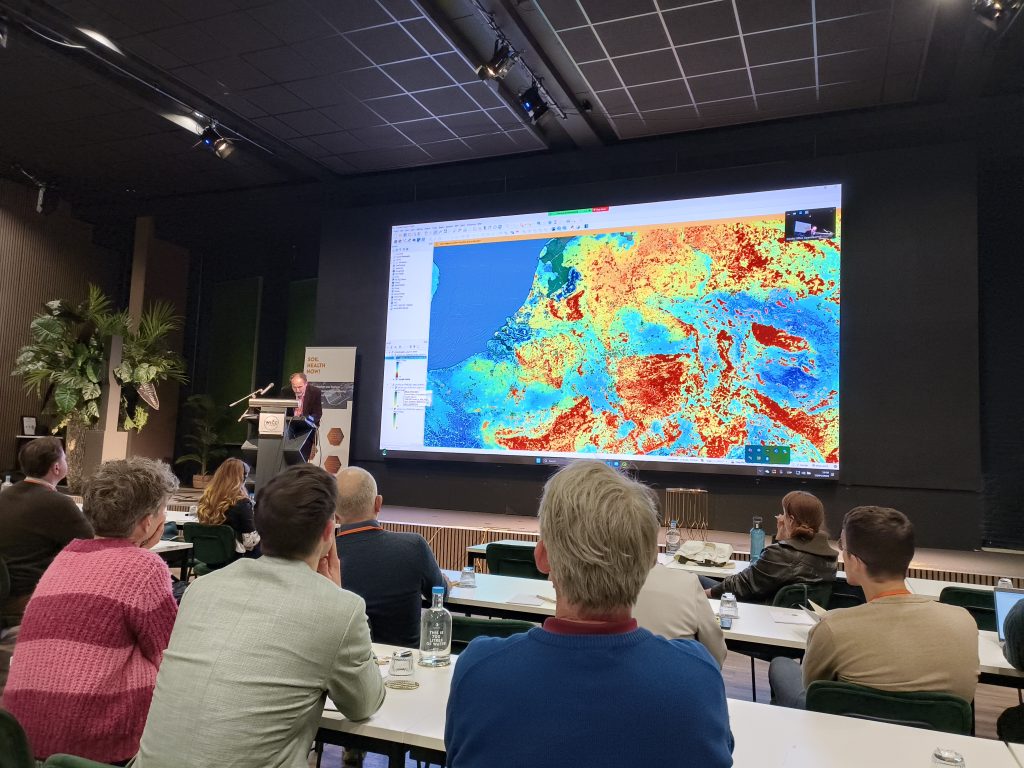

A pan-European team of scientists and soil innovation partners are inviting soil advisers, land managers, policymakers and researchers to help shape the next phase of AI4SoilHealth’s Soil Health Viewer. This AI-enabled platform is designed to support more informed land management, soil monitoring and evidence-based decision-making across Europe.

Built on AI4SoilHealth’s pioneering Soil Health Data Cube, the platform combines artificial intelligence, earth observation and publicly available soil data to provide high-resolution insights into soil condition and change over time. It is designed to help users access and interpret complex information more easily, supporting stronger evidence-based work on soil monitoring, advisory services, land management and policy implementation.
Tomislav Hengl of The OpenGeoHub Foundation said: “Healthy soils are central to climate resilience, food security, biodiversity and sustainable land management across Europe. AI4SoilHealth’s Soil Health Viewer shows what is possible when scientific expertise, digital innovation and stakeholder collaboration are brought together around a shared goal.”
He continued: “Significant work has gone into reaching this pilot phase. We are now at the point where real feedback and real user experience are essential. This is an opportunity to test what has been built, learn what works in practice, and further develop a tool with enormous potential to support more informed and consistent soil health action across Europe.”
A platform designed around real questions
A key feature of AI4SoilHealth’s Soil Health Viewer is its integrated chatbot, which allows users to interact with complex soil health information through plain-language questions. Alongside mapped indicators and layered visualisations, the chatbot is intended to help users explore evidence more easily, interpret trends and understand how the platform can support practical and policy-related work.
Examples of questions users may explore include:
- “What kind of crop are best suited for my land?”
- “How does the land in my farm compare with similar land in the region when it comes to XXX indicator?”
- “How has soil organic carbon changed over time at this location?”
- “How have land management indicators, for example tillage intensity and bare soil exposure, changed over time at this location?”
Users can also use the chatbot to help them interpret the data and understand the best ways of using this tool.
Supporting Europe’s soil health ambitions
The launch of the pilot comes at a timely moment for Europe. AI4SoilHealth is contributing knowledge and tools relevant to the EU’s evolving soil policy framework. As member states look to implement the Soil Health Monitoring law passed in 2025, tools like these could prove essential for establishing national soil monitoring schemes aimed at improving soil health. AI4SoilHealth’s Soil Health Viewer is one of a wider set of scientific and technical outputs being developed within the project to help support that ambition.
Mogens H Greve from Aarhus University said: “Open data and science-based tools will be essential if Europe is to build a shared understanding of soil health and accelerate progress towards healthier soils by 2050. Making AI4SoilHealth’s Soil Health Viewer available in pilot form creates an important opportunity to test how advanced soil intelligence can support policy implementation, advisory services and land management decisions in practice.”
The platform and its underlying components are being developed under open-source licences, with open data approaches used wherever possible. This reflects the project’s commitment to transparency, accessibility and long-term reuse.
Pilot phase opens for real-time feedback
The pilot phase marks a major milestone for the project, with the AI4SoilHealth consortium translating complex soil, climate and vegetation data into a practical platform ready for real-world testing. Although still in its first phase, AI4SoilHealth’s Soil Health Viewer already shows how AI-supported soil analysis can be delivered through a digital interface, allowing users to explore mapped indicators, examine changes over time and use the chatbot to interrogate available evidence more easily. The consortium is now seeking feedback from prospective users to understand how the platform performs in practice, where it delivers most value, and how it can be strengthened further.
Shaped through co-design
AI4SoilHealth’s Soil Health Viewer has already been informed by collaboration with project partners and prospective users, helping to shape both its development and direction. This co-design approach has been central to building a pilot that is scientifically robust, relevant to real-world needs and ready to learn from further user feedback.
Invitation to contribute feedback
The AI4SoilHealth consortium is now actively seeking feedback on the pilot phase of AI4SoilHealth’s Soil Health Viewer. Stakeholders are invited to comment on the user experience, the usefulness of the information provided, the kinds of questions the system should support, and how the platform could be strengthened for future deployment. This feedback will help ensure that the next phase of development is grounded in real user experience and aligned with operational and policy needs.
Stakeholders are encouraged to share their views through the project feedback survey by 15 July 2026. Find out more about the survey.
Further information
AI4SoilHealth is a pan-European initiative focused on advancing soil health monitoring, knowledge and action.
AI4SoilHealth’s Soil Health Viewer and its associated Soil Health Data Cube bring together knowledge, data and tools developed over the four years of the project to make advanced soil intelligence more accessible, usable and actionable. This pilot phase marks an important final-products moment for the initiative, as the project moves into its next and near-final stage of testing, feedback and wider engagement ahead of its concluding phase later in 2026.
While this technology represents a significant leap in soil science, users should note that this sort of digital soil mapping involves a degree of statistical uncertainty. These values are estimates based on available data and complex algorithms. Therefore, the Viewer should be seen as providing a high-fidelity ‘first look’ at soil health, signalling where on-farm verification is most critical.
How to use the Soil Health Viewer
To support users during the pilot phase, tutorials and short instructional videos are being made available.
Please note: This is product is still in development and during periods of high traffic, the platform may experience temporary capacity constraints. In such cases, users are encouraged to return and try again later.